
Congress Should Not Systematically Embed Israel into US Military
IMEU Policy Project Policy Memo #32
June 3, 2026
BACKGROUND
Section 224 of the Chairman's Mark of the FY2027 National Defense Authorization Act (NDAA)–the United States-Israel Defense Technology Cooperation Initiative–would establish a Defense Department Executive Agent (EA) who would be granted limitless and unaccountable authority for synchronizing and accelerating the US-Israeli bilateral military relationship.
The EA would do so by integrating Israeli weapons into US systems and programs; ensuring joint US-Israeli research initiatives; facilitating the transition from joint research and development to US procurement and acquisition; establishing joint ventures and licensing agreements for the co-production and co-development of weapons; and promoting joint military exercises and exchanges of information.
This section of the NDAA is similar to the United States-Israel FUTURES Act of 2026 (S.3855/ H.R.7540).
The House Armed Services Committee (HASC) will mark up the bill on June 4. Rep. Ro Khanna has announced that he will offer an amendment to strike Section 224 from the bill.
💡POLICY ASK: IMEU Policy Project strongly urges HASC members to vote YES on the Khanna amendment to strike Section 224.
DETAILS
Section 224 proposes the synchronization and acceleration of US-Israeli joint ventures, joint research and development, joint training exercises and information-sharing mechanisms, and co-production in a wide array of fields, including:
(1) Counter-Unmanned Systems including aerial, maritime, and ground platforms.
(2) Anti-tunneling and subterranean threats.
(3) Missile and air defense technologies.
(4) Artificial intelligence, quantum, machine learning, and autonomous systems.
(5) Directed energy and advanced sensing.
(6) Cyber defense, electronic warfare, and digital resilience.
(7) Biotechnology, biomanufacturing, and medical defense.
(8) Network integration, data fusion, and contested logistics.
(9) Defense industrial base cooperation, manufacturing, and co-production.
(10) Other emerging technologies as jointly agreed by the United States and Israel.
TOPLINES
The US already fails to hold Israel accountable–Section 224 would make accountability impossible. Taxpayer-funded weapons transfers to Israel through FMF are subject to human rights conditions in the Foreign Assistance Act (FAA) and Arms Export Control Act (AECA). According to the FAA, countries that engage in a consistent pattern of gross violations of human rights or which block the provision of US humanitarian aid are ineligible for any weapons transfers. In addition, the Leahy Laws of the FAA block weapons transfers to specific units of militaries guilty of gross violations of human rights. And the AECA prohibits weapons transfers to a country that uses US weapons for purposes other than internal security and legitimate self-defense, along with a few other narrow uses not relevant to Israel's use of US weapons against Palestinian civilians. All weapons transfers to Israel should end because of its clear violations of these laws.
However, by transforming the US-Israeli bilateral military relationship in the way envisioned by Section 224, the Executive Branch and Congress would lose the possibility of holding Israel accountable even if it chooses to enforce those laws. That is because these types of joint research and development and co-production are outside the frameworks of the FAA and AECA, enabling this military relationship to deepen no matter Israel's actions.
Section 224 singles out Israel for special privileges available to no other country. Israel already benefits from several special carveouts augmenting the value of US weapons giveaways and insulating it from accountability. For example, through the end of the current MOU, Israel is allowed to use a certain percentage of its FMF allocation to make purchases directly from Israeli weapons manufacturers–a US taxpayer subsidization of foreign weapons makers unavailable to any other FMF recipient. Israel, unlike most other countries, also gets the full value of its annual FMF appropriation deposited into an interest-bearing account (instead of in quarterly installments like most other countries), meaning that Israel is actually able to draw on an even greater amount of money for US weapons than appropriated by Congress. And Israel is the only country in the world that requires high-level State Department sign-off in US determinations of Leahy Law violations–one factor partially explaining the US refusal to hold Israel accountable.
Section 224 builds on this tradition of exceptionalizing Israel and holding on to its special privileges. No other country has an EA designated to synchronize and accelerate the US bilateral military relationship with it.
Section 224 raises concerns about the exporting of Israeli AI-warfare to the US and privacy concerns for Americans. While joint research and development and co-production already exist in some of these spheres, most notably in missile and air defense technologies, the proposed expansion into other spheres, particularly artificial intelligence (AI) and data fusion raise troubling implications. Widespread reports about Israel's use of AI-generated target lists and tracking tools through programs codenamed Lavender, The Gospel, and Where's Daddy during its ongoing genocide of Palestiniains in Gaza have raised concerns about machine error, and the indiscriminate and disproportionate attacks generated by AI with little or no human oversight. And engaging in partnerships for data fusion with Israeli companies also raises privacy concerns for US citizens, especially given the fact the Israeli government is paying US influencers to push Israeli propaganda.
Section 224 paves the way for unlimited taxpayer funds to benefit Israeli weapons manufacturers. Section 224 would create a statutory framework for a greater subsidization of Israeli weapons manufacturers. This sets the scene for the next Memorandum of Understanding (MOU), which is poised to establish a presidential commitment to seek expanded appropriations for it in budget requests. (For more details about the MOU, see Israel's Proposal to End US Military Funding Is Actually Designed to Further Enmesh the US in Its Oppression of Palestinians | IMEU Policy Project Policy Memo #27) It should also be noted that under the expansive powers granted to the EA by Section 224, it is possible the EA could funnel tens of billions of dollars in taxpayer funds in contracts to Israeli weapons makers even without explicit congressional authorization and appropriation.
The US is obligated to prevent Israel's violations of international law–it cannot bankroll Israeli weapons manufacturers, some of which are government-owned, that are profiting from Israel's violations of international law. As IMEU Policy Project outlined in a previously policy memo, the US is obligated to prevent and punish genocide, ensure respect for the Geneva Conventions, and not to aid or assist a state in committing a wrongful act. And the International Court of Justice (ICJ) has issued an advisory opinion that states cannot render aid or assistance to Israel in maintaining its illegal occupation of the West Bank, including East Jerusalem, and Gaza. (For details see: US and International Law Require Ending All Weapons to Israel | IMEU Policy Project Policy Memo #31.) Engaging in joint research and development and co-production of weapons with Israeli weapons manufacturers, some of which are government-owned and all of which profit from Israel's grave breaches of international law, violates these US legal obligations.
The US should not be deepening its military relationship with Israel. For over two years, Americans have been horrified by the images live-streamed from Gaza. Israel's violence against Palestinians has played a large part in historic decreases in support for Israel and in historic degrees of sympathy for Palestinians. Now Israel is explicitly exporting its model of violence from Gaza to Lebanon, where Israel is killing thousands of Lebanese people, attacking hospitals and first responders, demolishing entire Lebanese villages, and forcibly displacing more than 1 million people–just like in Gaza. And Israeli Prime Minister Benjamin Netanyahu dragged the US into an unconstitutional and illegal attack against Iran which has killed thousands of Iranian civilians and greatly aggravated the affordability crisis for people in the US. Considering this context, Congress should not deepen military ties to Israel.
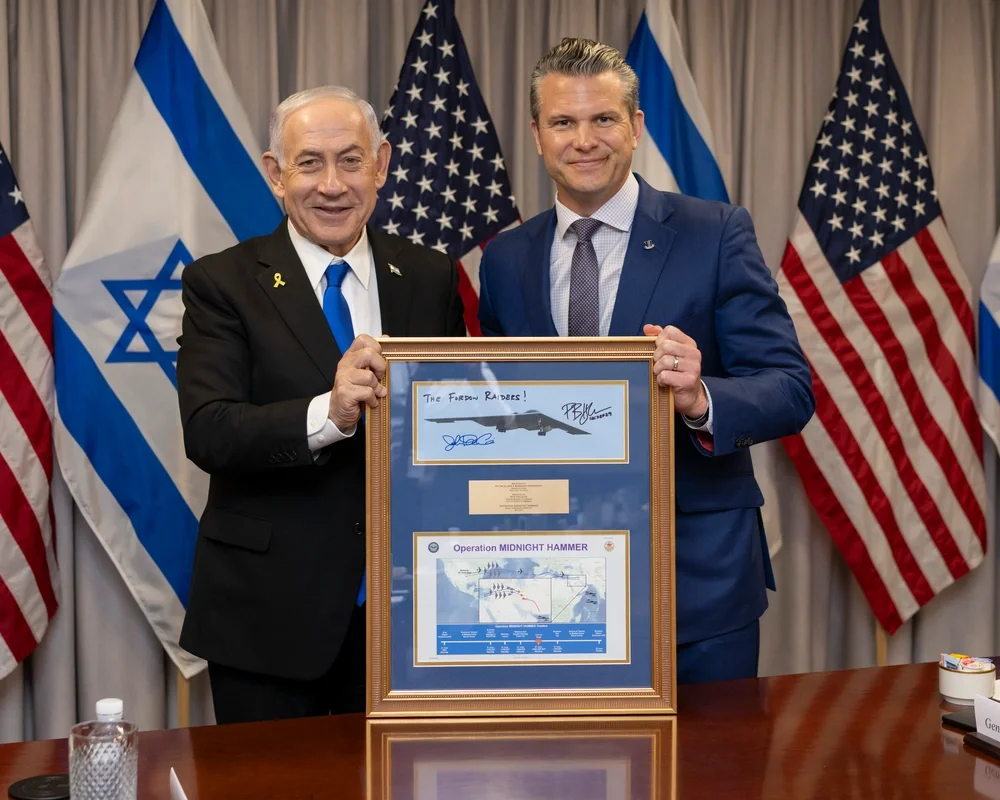
Photo: Defense Visual Information Distribution Service